|
|
|||||
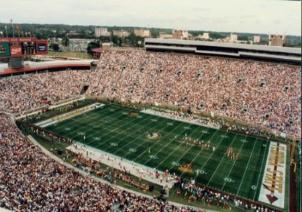
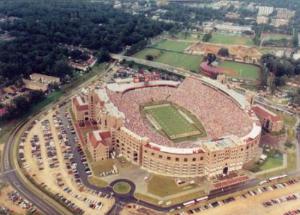
| Doak Campbell Stadium From a maximum capacity of 15,000 in 1953 to a record crowd of 83,042 against Florida in 2000, Doak S. Campbell Stadium has risen alongside the Florida State football program to the top of the college football ladder. With the final phase of construction completed, Seminole fans are welcomed with state-of-the-art additions. The newest portion of the stadium is the south end zone, where the last bricks have been placed on the exterior of the stadium wall and the interior received its final finishing touches. The south end zone houses the Florida State school of hospitality education where students in the program receive hands-on experience in various aspects of the food and beverage industry. The multi-level facility includes a food court, a restaurant and a sports grill on the top floor that gives a panoramic view of Doak Campbell Stadium. The north endzone, which consisted of wood bleachers until the 1994 season kicked off, is topped by the offices of the football coaches. The offices are just part of the Daisy Parker Flory wing of the Moore Athletic Center which include a number of amenities for the football staff. An even more drastic change is currently taking place as the new north endzone building is under construction to be ready by the start of the 2003 football season. Towering above college football action from the east side are skyboxes which stretch from goal line to goal line. New skyboxes are located above the west stands on the eighth floor. The west addition also houses the president's level on the seventh floor (which includes an open air terrace in the northwest corner) and one of the largest press boxes in college football with seating for over 250 members of the media. A brick facade surrounds the stadium, matching the architectural design of most of the buildings on the Florida State campus. The University Center surrounds Doak Campbell Stadium and houses numerous offices that were located on the interior of the FSU campus. Inside Doak Campbell, the lowest tier of field level seats were removed, providing increased sideline space and better viewing lines for the first few rows of fans. A matching brick wall was constructed along the east and west sidelines, limiting field access, increasing safety and giving the inside of the stadium a whole new look. In its last 86 home games, FSU is 81-4-1. Bobby Bowden's Florida State teams have lost only 18 games at home in 26 years, giving the coach an impressive 132-18-2 record and an .875 winning percentage in Tallahassee. A milestone was reached on September 28, 1996 when Bowden won his 100th game in Doak Campbell Stadium as FSU's head coach with a 13-0 victory over North Carolina. But the winning tradition of Doak Campbell Stadium, which was named after former FSU president Doak S. Campbell, goes back before Bowden. All-time, Florida State is 214-68-4 in 284 home games for a winning percentage of .755. Since the stadium opened on Oct. 7, 1950 with Florida State University taking a 40-7 victory over the Randolph-Macon Yellowjackets, millions of fans have packed Doak Campbell to see the finest in college football action. In 2001, Florida State set a single season attendance mark by drawing 488,645 fans over six home games. The latest expansion is the ninth in the history of the stadium. The current capacity of 82,000 reflects an increase of 21,481 since the end of the 1991 season. Florida State first began play at Centennial Field during the inaugural 1947 season. In the three seasons that the Seminoles called Centennial Field their home, FSU had an overall home record of 8-4, including Coach Don Veller's undefeated 8-0 home mark over the 1948 and '49 seasons. It's hard to imagine the first Doak Campbell Stadium, with a capacity of 15,000 back in 1950. In 1954, the stadium grew to a capacity of 19,000. Six thousand more seats were added in 1961. During the Bill Peterson era (1960-70), the stadium was expanded to 40,500 seats, and it remained at that capacity for the next 14 years. Between 1978 and 1982, there were three more additions. The field itself is one of the finest in college football, carefully managed and manicured year-round. A prescription athletic turf (PAT) system installed in 1988 and completely resodded three years ago, quickly alleviates drainage problems through a series of underground pumps. The field can go from flooded to merely wet in a matter of minutes, thanks to the pumps, which allow a deeper root system in the natural turf. The 1999 season marked another new addition to Doak Campbell Stadium as FSU unveiled the War Board video system. The big screen presentation is crystal clear and allows game day producers to show highlights of games all over the country to Seminole fans watching their team in the stadium. With the changes already made since last season, Doak Campbell is growing and improving faster than ever before. Like its residents, the most successful college football program over the past decade, Doak Campbell Stadium has become a fitting showcase for Florida State University. |
|||||
 | |  | |  | |  | |  |